

George Orwell (Eric Arthur Blair) was born on June 25, 1903, in India, where his father worked as a British colonial administrator. He grew up in England, where he studied at the Elton collage.
In 1922, after working as a teacher and an employee in Burma, Orwell returned to England, where he became a writer and journalist. Back in England he lived through a period of poverty, where he found himself having to face humble jobs and came into direct contact with the lives of the poorest.
These experiences were fundamental for the writing of his first important book: “down and out in Paris and London”, in which he realistically recounts the life of the poor in the two capitals.
He is famous for his works that address themes of social injustice and totalitarianism.
His most famous works are “1984”, a dystopian novel that critiques surveillance and repression under a totalitarian regime, and “Animal Farm”, a satire of totalitarianism, particularly against the Soviet Stalinist regime.
Orwell also wrote numerous essays and reports, including “Homage to Catalonia”, which reflects his experience in the
Spanish Civil War. He died on January 21, 1950, from tuberculosis, at the age of 46.
George Orwell was a politically committed writer who denounced totalitarianism, social inequalities, and the manipulation of power, defending freedom and truth as fundamental values for a just society.
His political commitment is also reflected in his experience in the Spanish Civil War, which led him to denounce the internal divisions among progressive forces.
1984
George Orwell
It is a dystopian novel set in a totalitarian future where individual freedom is completely suppressed. The story
takes place in the state of Oceania, where the Party controls every aspect of people’s lives.
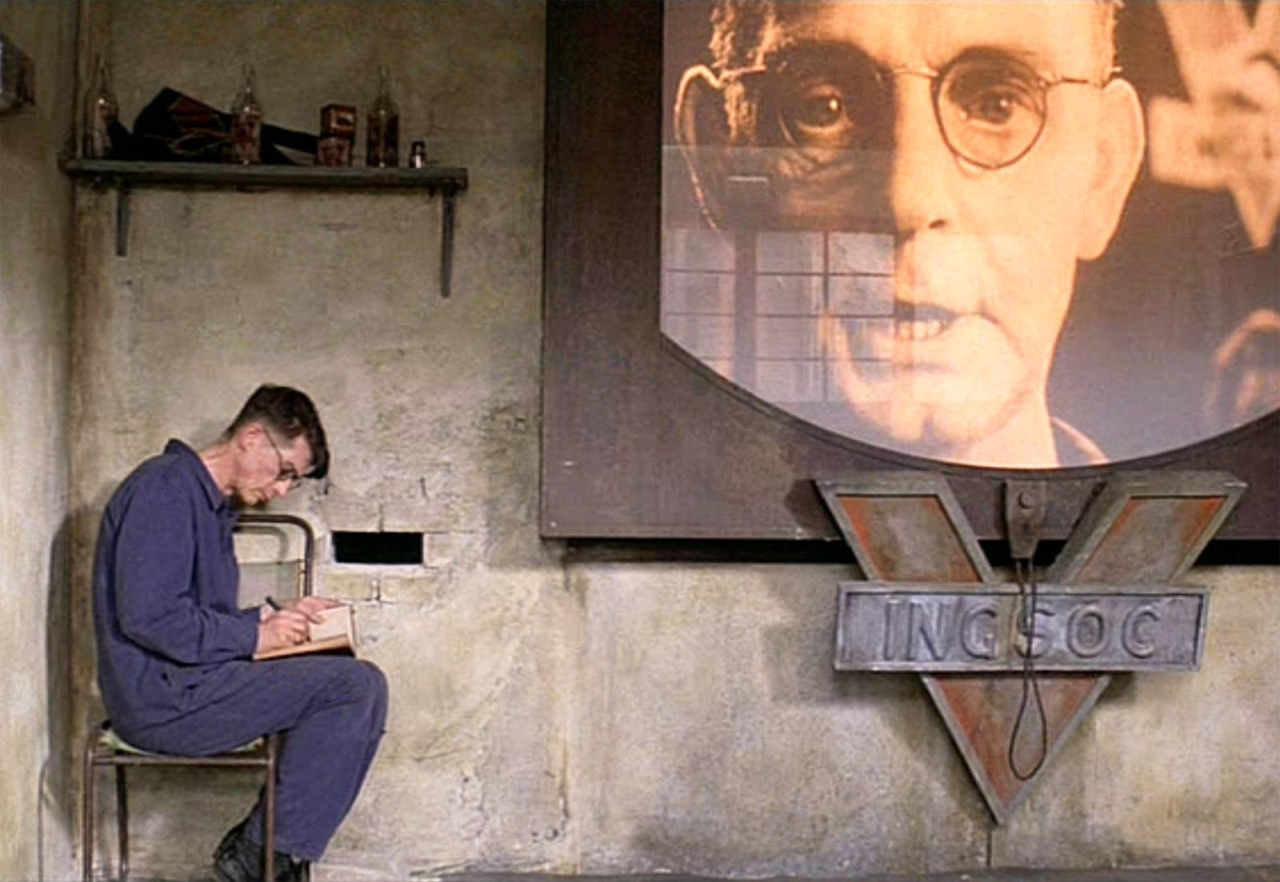
The government is led by Big Brother, an omnipresent figure representing absolute power and constant surveillance
people are constantly watched through devices called telescreens, which monitor behaviors and speech.
The protagonist, Winston Smith, is an employee who works at the Ministry of Truth, where his task is to rewrite history to match the ocial versions established by the Party.
Every day, Winston destroys documents and rewrites books and articles to eliminate any trace of the past that doesn’t conform to the Party’s narrative.Despite his work, Winston secretly develops a hatred for the Party and dreams of a revolution that could bring back freedom and truth.
He starts keeping a secret diary in which he expresses his thoughts against the regime, an act considered a serious
crime, since the Party doesn’t tolerate any form of independent thought.
Winston begins a relationship with Julia, a colleague who works with him at the Ministry of Truth, and she, too, is against the Party. Despite the Party prohibiting any form of love, Winston and Julia begin a relationship, committing another crime.
Winston and Julia try to resist the Party and meet O’Brien, an ocial who seems to be on their side. O’Brien introduces
them to the Brotherhood, a rebel organization that wants to overthrow the Party. However, it is revealed that O’Brien is actually a Party agent who betrays them.
They are arrested by the Thought Police, and Winston is taken to Room 101, a place where he is tortured and is forced to give up his ideals and betray Julia. O’Brien uses torture to break his will to resist.
So, in the end, Winston accepts the Party’s ideology and loves Big Brother. The novel ends with Winston completely
submissive to the regime, symbolizing the victory of totalitarianism.
The name “Winston Smith” is symbolic. “Winston” evokes Winston Churchill, a leader known for his resistance against totalitarianism. “Smith,” on the other hand, is a very common name. Therefore, Winston Smith represents the rebellion of an ordinary man in society.

ANIMAL FARM
George Orwell
Is a novel by George Orwell, which tells the story of a group of animals who rebel against their human owner
Mr. Jones, to gain freedom and equality.
The revolution begins when the wise pig, Old Major, urges the animals to overthrow human rule, creating a new society, “Animal Farm,” where the farm’s rules are based on principles of equality.
However, over time, the pigs gain more power and begin to resemble the humans they had overthrown.
The farm, once a symbol of hope and justice, becomes a totalitarian regime where the pigs dominate the other animals.The allegory of Animal Farm is a critique of totalitarianism, showing how revolutionary leaders can betray the original principles to pursue their own power
